

Essential Safety Standards for Manufacturing Children’s Drinkware
When designing and manufacturing drinkware for children, safety is not a selling point—it is a non‑negotiable baseline. Parents, schools, and childcare providers expect children’s cups, bottles, and tumblers to be free from harmful substances, robust enough to withstand daily use, and easy to clean. As a specialized drinkware manufacturer, LENO Drinkware focuses on bringing products to market that meet or exceed global safety standards while delivering practical, attractive designs for kids.
Why Safety Standards Matter in Children’s Drinkware
Children are more vulnerable to chemicals, bacteria, and physical injury than adults. They also tend to chew on straws, drop bottles frequently, and use their cups in a wide range of settings—from home to playground to classroom. For brands, retailers, and importers, compliance with safety standards is both a legal requirement and a core part of brand reputation management.
LENO Drinkware designs and manufactures products with this in mind, integrating compliance into material selection, tooling, production, and testing for every children’s drinkware project.
Key Global Regulations for Children’s Drinkware
While specific requirements vary by country and region, there are several regulatory frameworks that children’s drinkware manufacturers typically need to consider. LENO Drinkware supports clients in aligning with the relevant standards for their target markets.
1. Food-Contact Material Regulations
Any part of a child’s drinking cup or bottle that touches liquids or the mouth must meet food‑contact safety requirements.
- EU Framework Regulation (EC) No 1935/2004: Ensures materials in contact with food do not transfer substances in quantities that could endanger health or change food composition or taste.
- EU Plastics Regulation (EU) No 10/2011: Applies to plastic components, covering migration limits for a wide range of chemicals.
- US FDA 21 CFR: Defines which plastics, coatings, and colorants are permitted for food‑contact applications and under what conditions.
LENO Drinkware sources certified food‑grade raw materials and works with testing partners to verify migration limits and compliance with these core frameworks.
2. Heavy Metal and Chemical Safety
Children’s drinkware must be free of heavy metals and hazardous chemicals that can migrate into drinks:
- Lead and cadmium: Limits apply to coatings, decorations, and metal components.
- BPA and BPA‑like substances: Many markets restrict or ban bisphenol A in children’s products, especially for baby and toddler drinkware.
- Phthalates and plasticizers: Often restricted in soft plastics, seals, and printed elements.
- REACH (EU): Controls substances of very high concern (SVHCs) in materials.
By adopting BPA‑free plastics (such as selected grades of Tritan or PP), employing compliant paints and inks, and using stainless steel that meets food‑grade requirements, LENO Drinkware helps brands reduce chemical risk in kids’ products.
3. Mechanical and Physical Safety Standards
Beyond chemistry, physical design is crucial. Children’s drinkware must be robust, stable, and designed to minimize choking or injury risks.
- EN 14350 (Europe): Covers drinking equipment for children, including bottles and cups—focusing on mechanical performance, leakage, and hygienic design.
- EN 71 (relevant parts) / ASTM F963: Toy safety standards that often apply when drinkware has toy-like features or is marketed to very young children.
- Small parts and choking hazards: Components such as detachable straws, valves, and decorative elements must not detach easily and must meet small‑parts requirements for young children.
LENO Drinkware incorporates robust structures, secure assemblies, and age‑appropriate sizing to support compliance with these physical safety expectations.
4. Temperature and Thermal Safety
Children’s drinkware is frequently used for both cold and warm beverages, making thermal safety another core consideration:
- Resistance to hot liquids without deforming or releasing harmful substances.
- Cool‑touch exteriors for insulated stainless steel bottles to protect small hands.
- Clear warnings and usage guidelines regarding microwave, dishwasher, and boiling‑water use.
LENO Drinkware conducts thermal testing and advises clients on appropriate temperature ratings and usage symbols for kids’ bottles and cups.
Safe Material Choices for Children’s Drinkware
Material selection is at the center of safe product design. LENO Drinkware works with a range of materials that are widely accepted for children’s drinkware when properly certified and tested.
1. Food-Grade Plastics
Plastics are popular in kids’ cups and bottles because they are lightweight and impact‑resistant.
- PP (Polypropylene): Common for lids, spouts, and bodies; typically BPA‑free and suitable for warm liquids within specified temperatures.
- Tritan™ or similar copolyesters: Transparent, tough, and BPA‑free; ideal for clear bottles that showcase drink levels or designs.
- Silicone: Used for straws, seals, and soft spouts; offers gentle contact with children’s teeth and gums.
LENO Drinkware ensures plastic resins come with material declarations and test reports, and can support additional third‑party testing based on customer requirements.
2. Stainless Steel
Stainless steel has become increasingly popular for children’s drinkware due to its durability and thermal performance.
- Food-grade stainless steel (e.g., 304/18-8): Resistant to corrosion and suitable for repeated contact with liquids.
- Double-wall vacuum insulation: Keeps drinks at stable temperatures and reduces condensation.
- Non‑leaching: When properly finished and tested, stainless steel does not transfer harmful substances into drinks.
LENO Drinkware uses high‑quality stainless steel for children’s insulated bottles, combined with safe, BPA‑free plastic lids and silicone seals.
3. Coatings, Inks, and Decorative Elements
Children’s products often feature colorful graphics and character designs. These must also meet safety requirements:
- Non‑toxic coatings that comply with heavy metal and solvent limits.
- Food‑safe inks for any designs that may come into contact with a child’s mouth or the liquid inside.
- Securely bonded graphics that do not flake or peel easily under normal use and washing.
LENO Drinkware works with compliant coating systems and printing processes to ensure decorative appeal does not compromise safety.
Design Principles for Safer Children’s Drinkware
Safety is also about thoughtful, detail‑oriented design. At LENO Drinkware, design teams and engineers collaborate to integrate safety principles at the concept stage.
1. Age-Appropriate Functionality
- Spouts and straws designed for the intended age group, with suitable flow rates.
- Handles and grips sized for small hands, reducing the risk of drops and spills.
- Simple mechanisms that young children can operate without excessive force, yet secure enough to prevent accidental opening in bags.
2. Prevention of Choking and Ingestion Risks
- Avoiding detachable small parts on products intended for children under three.
- Reinforced attachment of valves, seals, and decorative pieces.
- Testing for bite resistance where children may chew on spouts or straws.
3. Leak-Proof and Spill-Resistant Construction
Leaking bottles not only cause inconvenience but can also encourage mold growth in bags or poorly dried components.
- Well‑designed sealing systems using food‑grade silicone gaskets.
- Spill‑resistant valves for toddlers and younger children.
- Pressure and drop testing to verify long‑lasting leak‑proof performance.
4. Hygienic and Easy-to-Clean Design
Complex shapes, hidden cavities, or difficult‑to‑remove parts can trap moisture and encourage bacterial growth.
- Fewer, larger parts that are easy for parents to disassemble and reassemble.
- Smooth internal surfaces and rounded corners that are easier to wash.
- Clear guidance on dishwasher compatibility and recommended cleaning methods.
LENO Drinkware emphasizes hygienic design, helping brands create products that are not only safe when new but remain safe in real‑world use.
Quality Control and Testing in Production
Meeting safety standards is not only about design and material choice. Reliable manufacturing and quality control are essential for consistent compliance across every batch.
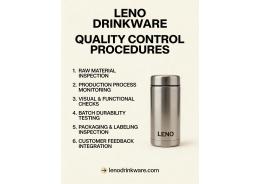
1. Incoming Material Inspection
LENO Drinkware checks incoming raw materials against specifications and supplier documentation, verifying food‑grade status, material grades, and surface quality before production begins.
2. In-Process Quality Checks
Throughout production, key dimensions, assembly performance, and functional properties are monitored:
- Fit between lids, bodies, and seals.
- Leak tests for assembled bottles and cups.
- Visual inspection for sharp edges, burrs, and surface defects.
3. Finished Product Testing
Before shipment, children’s drinkware can be tested according to the relevant standards for the target market:
- Migratory testing for heavy metals and organic compounds.
- Mechanical tests such as drop, pull, and bite tests.
- Thermal resistance and dishwasher testing, where applicable.
LENO Drinkware works with accredited laboratories to provide test reports that support clients’ compliance documentation and market access.
Labeling, Instructions, and Transparency
Clear and accurate labeling is another part of safety. Parents need to understand how to use and care for children’s drinkware correctly.
- Age recommendations (e.g., 12+ months).
- Usage limitations (e.g., not suitable for carbonated drinks or boiling water where relevant).
- Cleaning instructions, including dishwasher and sterilization guidance.
- Material information and BPA‑free or phthalate‑free claims backed by testing.
LENO Drinkware supports clients with labeling recommendations aligned with the intended markets and product features.
How LENO Drinkware Supports Safe Children’s Drinkware Projects
Developing compliant children’s drinkware requires coordination among design, engineering, sourcing, and regulatory teams. As a professional drinkware manufacturer, LENO Drinkware offers end‑to‑end support for brands looking to build or expand a kids’ product line.
- Design and engineering support focused on ergonomics, safety, and manufacturability.
- Material selection guidance for plastics, stainless steel, seals, and coatings.
- Prototype development to validate usability and compliance before mass production.
- Quality management to keep every production run aligned with agreed safety specifications.
From baby training cups to insulated stainless steel children’s bottles, LENO Drinkware helps bring safe, durable, and attractive products to market.
Conclusion
When manufacturing drinkware for children, brands must consider a complete safety picture: chemical and material safety, mechanical performance, thermal properties, hygienic design, and accurate labeling. Working with an experienced manufacturing partner like LENO Drinkware gives you access to proven materials, robust engineering, and quality systems designed around global standards.
If you are planning a new children’s drinkware collection or upgrading an existing range, integrating these safety standards from the beginning of your project will help protect young users and strengthen your brand’s reputation in a competitive market.


 English
 German
 French
 Russian
 Spanish
 Japanese
 Korean
 Khmer
 Portuguese
 Ukrainian
 Arabic
 Italian
 Afrikaans
 Albanian
 Armenian


